Roll Pressing Process of Lithium Battery Electrodes
Introduction: After coating and drying, the peeling strength between the active material and the current collector foil of the electrode is very low. Therefore, roll pressing is required to enhance the adhesion between the active material and the foil, preventing peeling during electrolyte immersion and battery use.
Introduction: After coating and drying, the peeling strength between the active material and the current collector foil of the electrode is very low. Therefore, roll pressing is required to enhance the adhesion between the active material and the foil, preventing peeling during electrolyte immersion and battery use. Meanwhile, roll pressing can compress the cell volume, improve the energy density, reduce the porosity among the active material, conductive agent, and binder in the electrode, lower the battery resistance, and enhance battery performance.
1. Introduction to Roll Press Machines To improve the density and thickness uniformity of the battery electrode surface material, the positive and negative electrodes must undergo roll pressing after the coating process, which is known as the electrode roll pressing process. To ensure the precision requirement of thickness uniformity, the ratio of roll length to diameter is often small, resulting in a narrow rolling width of the electrode.

The complete rolling process is as follows: fix the coated electrode on the unwinding mechanism, thread the electrode through the gap between the two rolls correctly, and connect it to the winding system. After activating the rolling mode, the motor drives the upper and lower rolls to rotate simultaneously, and the winding mechanism pulls the electrode to pass steadily through the rolling gap, finally being pressed to the required compaction density. When the roll press is not in use, a thin oil layer should be applied to prevent rusting. Before use, wipe off the oil layer with anhydrous ethanol and clean the unwinding and winding mechanisms as well as the automatic deviation correction mechanism. Therefore, an excellent roll press must include the following eight functional modules:
Eight Functional Modules of Roll Press Machines
Roll Pressure Adjustment and Quick Response Function: Adjusting the pressure between the two rolls of the roll press is necessary to improve the compaction density of the active material in the battery electrode. Due to factors such as coating intervals and single/double-sided alternation, the pressure adjustment between the two rolls must respond quickly.
Roll Gap Adjustment and Accurate Reset Function: Adjusting the gap between the two rolls of the roll press is necessary to obtain the thickness of the battery electrode. Due to changes in the electrode coating method and the need for electrode tape joining, the gap between the two rolls needs to be accurately reset after quick adjustment.
Tension Adjustment and Quick Response Function Before and After Electrode Rolling: Adjusting the front and rear tension during the battery electrode rolling process can control the flatness of the electrode shape. The quick response of tension control during rolling is an important means to prevent tape breakage when the rolling line speed suddenly changes.
Stepless Speed Regulation of Rolls and Linear Velocity Synchronization Function: The battery electrode roll press must perform stepless speed regulation on the two rolls during start-stop or according to process requirements, while ensuring that the linear velocities of the two rolls are consistent.
Electrode Rolling Temperature Adjustment Function: Adjusting the rolling temperature of the battery electrode can directly affect the deformation resistance and plastic deformation amount of the electrode during rolling.
Roll Deformation Correction Function: During the battery electrode rolling process or temperature adjustment, the two rolls will inevitably have axial deflection and radial expansion deformation. Correcting roll deformation directly affects the thickness uniformity and compaction density uniformity of the battery electrode.
Intelligent Control Function of Electrode Rolling Process: With the continuous improvement of electrode rolling speed and automation, closed-loop control or even intelligent control is required for automatic loading/unloading, automatic tape joining, automatic pressure application, automatic gap adjustment, and online monitoring.
Roll Cleaning and Maintenance Function: Powder sticking to the surface of the two rolls is common during the battery electrode rolling process. Keeping the roll surface clean can reduce roll wear and improve the surface quality of the battery electrode. Easy maintenance of the roll press is also a necessary function.
Laboratory often uses manual screw-driven electrode rolling mills. They apply pressure to the electrode by setting the roll gap value without additional pressurization devices. Therefore, the actual pressure is generally small, limiting the compaction density of the rolled electrode. Moreover, the maximum roll gap is restricted by the mechanical device, usually unable to roll very thick electrodes.
In addition, electrode rolling is divided into cold rolling and hot rolling. Currently, foreign countries have widely adopted hot rolling for electrode rolling, while domestic manufacturers mostly use cold rolling. Compared with cold rolling, hot rolling has the following advantages:
❖Removes moisture inside the electrode and reduces internal stress, thereby minimizing defects caused by internal stress release during slitting or die-cutting.
❖Reduces material rebound after electrode rolling, lowers the deformation resistance of the battery electrode, and is conducive to improving the liquid absorption capacity of the active material.
❖Since the material is in a molten state during heating, hot rolling can increase the adhesion between the active material and the current collector, reduce powder shedding during battery charge-discharge cycles, and improve the battery's cycle life.
In terms of rolling procedures, it can be divided into single rolling and multiple rolling. The multiple rolling process is relatively complex but can reduce electrode rebound, resulting in better electrode gloss and higher thickness uniformity.
2. Purpose of Roll Pressing
The compaction density of the electrode has a significant impact on the electrochemical performance of the battery. Within a certain range, as the compaction density increases, the distance between active material particles decreases, the contact area increases, and more ion-conductive pathways and bridges are formed, which macroscopically manifests as a decrease in the internal resistance of the battery. However, if the compaction density of the electrode is too high, the contact between active material particles is too close, increasing the electron conductivity. But the lithium ion channels decrease or become blocked, which is not conducive to capacity performance. During discharge, polarization increases, voltage drops, and capacity decreases. When the compaction density is too low, the particle spacing is large, the lithium ion migration channel is unobstructed, the electrolyte absorption capacity is strong, and it is conducive to the movement of lithium ions inside the battery. However, due to insufficient close contact between particles, it is not conducive to electron conduction. During discharge, it is prone to increased polarization.
Necessity of roll pressing: After coating and drying, the peeling strength between the active material and the current collector foil is very low. At this time, roll pressing is required to enhance the adhesion between the active material and the foil, preventing peeling during electrolyte immersion and battery use.
The purposes of rolling are as follows:
❖Ensure the electrode surface is smooth and flat, preventing burrs on the coating surface from piercing the separator and causing short circuits.
❖Compact the electrode coating material to reduce the electrode volume and improve the battery energy density.
❖Make the active material and conductive agent particles contact more closely to improve electron conductivity.
❖Enhance the bonding strength between the coating material and the current collector, reduce powder shedding of the battery electrode during the cycle, and improve the cycle life and safety performance of the battery.
3. Electrode Roll Pressing Process and Control
3-1. Rolling Process The rolling process of the battery electrode is the process in which the electrode is drawn into the rotating rolls by the friction between the rolls and the electrode, and the electrode is compressed and deformed. The rolling of the battery electrode is different from that of steel blocks. The steel rolling process is a process in which iron molecules extend longitudinally and widen transversely, and its density does not change during the rolling process; while the rolling of the battery electrode is a process in which the battery materials on the positive and negative electrodes are compacted. When the battery electrode is rolled, the rolling force should not be too large or too small, and should conform to the characteristics of the battery electrode material.
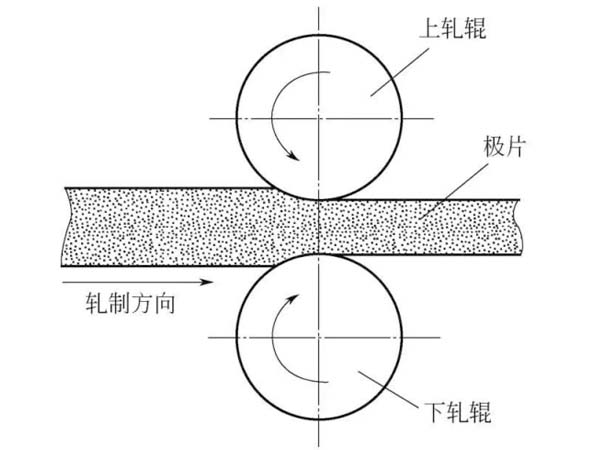
3-2. Rolling Control Basic mechanism of battery electrode rolling: Battery electrode rolling belongs to powder rolling, aiming to improve the compaction density and uniformity of the active material in the battery electrode, enhance the adhesion of the active material, and improve the surface roughness. The rolling process follows the law of constant weight.
Vertical Compaction and Longitudinal Extension: During the rolling process, the pressure of the two rolls on the battery electrode is actually the resultant force of vertical pressure and horizontal pressure, and its magnitude depends on the compression amount of the electrode active material and the roll bite angle. Under the premise of a certain compression amount of the electrode active material, the magnitude of vertical pressure and horizontal pressure depends on the bite angle of the two rolls. A large bite angle results in large horizontal pressure, and a small bite angle results in large vertical pressure. The compaction density depends on the magnitude of vertical pressure, and the longitudinal elongation depends on the magnitude of horizontal pressure.
Electrode Compaction Density Uniformity and Surface Roughness: Assuming that the electrode coating thickness is uniform, the compaction density uniformity of the battery electrode depends on the parallelism of the contact busbars between the two rolls. The influencing factors mainly include roll coaxiality, roll cylindricity, bearing accuracy, equipment rigidity stability, and gap adjustment at both ends of the roll. The surface roughness of the electrode after rolling depends on the particle size of the active material and the surface roughness of the rolls.
Current Collector Extension and Active Material Particle Slip: The aluminum foil or copper foil current collector is difficult to extend on the large-diameter roll rolling equipment, but the active material bonded to the current collector will slip under the push of horizontal pressure, thereby driving the extension of the battery electrode current collector. The elongation affects the flatness and conductivity of the electrode.
Local Extension Compression and Uneven Internal Stress of Battery Electrode: There is an error in the coating thickness of the battery electrode after coating, and there is also an error in the parallelism of the contact busbars of the two rolls. For this reason, the local compaction density of the active material on the battery electrode is not uniform, and the coexistence of local extension and surrounding compression causes uneven internal stress of the electrode, which in turn affects the flatness of the battery electrode shape.
Electrode Compaction Density, Elongation and Roll Neck: The size of the bite angle of the two rolls directly affects the compaction density and elongation of the electrode active material, and the size of the roll body diameter directly determines the size of the bite angle. A large roll diameter results in a small bite angle, and a small roll diameter results in a large bite angle.
Electrode Rolling Thickness Rebound and Rolling Speed and Environmental Humidity: A slow rolling speed will reduce the elastic deformation of the electrode active material, that is, the thickness rebound after rolling will become smaller. However, the fact is that when the rolling speed is increased to a certain value, the thickness rebound after electrode rolling becomes smaller instead, which is caused by environmental humidity. The water absorption of the active material not only affects the surface alkalinity of the active material but also affects the thickness rebound.
Uneven Internal Stress of Electrode Rolling and Tension Control: The electrode rolling process is a process of compression deformation and extension deformation. In this process, the inlet tension affects the internal stress distribution of the electrode, and the outlet tension affects the flatness of the electrode shape.
Hot Rolling and Deformation Resistance of Electrode: Generally speaking, the deformation resistance of materials will decrease with the increase of temperature, and the plastic deformation amount will also increase. Hot rolling of electrodes is also conducive to reducing roll surface wear. However, the comparison between cold and hot rolling of electrodes has not shown obvious effects, which shows the complexity of the influencing factors of electrode rolling.
4. Problems in the Rolling Process and Solutions
4-1. Uneven Electrode Thickness There are many factors causing uneven thickness of the rolled electrode, such as uneven coating thickness of the electrode, coaxiality error of the rolls, cylindricity error of the rolls, non-parallel contact busbars of the rolls, axial deflection deformation of the rolls, poor rigidity stability of the rolling equipment, etc.
Transverse Thickness Non-Uniformity: During the electrode rolling process, the situation of inconsistent thickness measurement on the left and right sides of the electrode often occurs. When the left and right thickness of the electrode is inconsistent, the influence of the electrode coating process should be excluded first. When the left and right thickness of the unrolled electrode is consistent during the test, the left and right rolling pressure needs to be adjusted to ensure that the left and right compaction densities of the rolled electrode are consistent. During the rolling process, the electrode should be tested regularly to prevent changes in pressure during rolling.
Longitudinal Thickness Non-Uniformity: Sometimes, after the electrode is rolled, the test electrode thickness meets the requirements, but the thickness increases again during slitting. This is the rebound phenomenon of the electrode. The rebound of the electrode is mainly due to more internal moisture of the electrode and too fast rolling speed. The electrode rebound problem can be solved by using hot rolling process and controlling the rolling speed.
4-2. Electrode Scythe Bending This situation is mainly caused by the non-parallel contact busbars of the two rolls or the different thickness of the two sides of the electrode coating. Since the edge thickness is a few microns or tens of microns larger than the middle part, when the rolling pressure of the rolling roll acts on the electrode, the area with larger edge thickness bears greater rolling force, resulting in inconsistent transverse compaction density of the rolled electrode, causing serious warpage of the electrode, which will also have an adverse impact on the subsequent slitting process. To control warpage, the key is to control the coating quality of the electrode. By controlling parameters such as slurry surface tension, pump pressure, tape running speed, and rolling pressure, the warpage of the electrode can be effectively reduced, of course, under the condition of meeting the design requirements.
4-3. Electrode Wave Edge This situation is mainly caused by a large elongation during the electrode rolling process. The causes are small roll body diameter, small tension before electrode rolling, large electrode thickness compression amount, protrusion on both sides of electrode coating, etc. When the electrode is rolled, the active materials squeeze each other and apply a certain pressure to the copper foil and aluminum foil, which will produce a certain extension. During rolling, the part without active material coating does not extend, while the electrode with active material produces extension under the action of rolling force. The inconsistent extension forms wavy wrinkles at the edge of the foil belt in appearance, and the parallel wave traces are perpendicular to the movement direction of the foil belt.
4-4. Dark Stripes on Electrode Surface This situation is mainly caused by vibration marks on the roll surface, large cylindricity error of the roll body, and small and uneven front tension.
4-5. Electrode Edge Curling This situation is caused by excessive electrode elongation. The solutions are mainly to increase the roll body diameter, reduce the electrode compression amount, and adjust the front and rear tension of the electrode.
4-6. Electrode Tape Breakage This situation is mainly caused by uneven and unstable tension, lack of tension quick response mechanism, serious protrusion at the edge of electrode coating, etc. For example, in the coating process, if there are small particles and other uneven textures on the electrode surface, during rolling, the small particles will be squeezed toward the foil belt under the pressure of the double rolls. The softer particles can be rolled into powder and then fall off, and the harder particles will squeeze the foil belt, causing holes or even breakage of the foil belt; in the coating process, if the surface density of the electrode surface is different, during the rolling process, one piece will be over-rolled and the other piece will be under-rolled. In the process of electrode tape running, under the same tension control, the under-rolled part will have some active material falling off or even foil breaking. Controlling the winding tension and preventing large particle impurities from falling on the electrode surface can effectively reduce electrode breakage.
4-7. Different Tensions on Both Sides of the Electrode This situation is mainly caused by the non-parallelism of the roll axis and the axes of each passing roll, which can be solved by adjusting the parallelism of each roll axis.
4-8. Pitting on Roll Surface This situation is the fatigue pitting of the roll surface, mainly caused by the uneven metallographic structure of the roll material and heat treatment, poor fatigue strength of the roll surface, and also related to the surface roughness of the roll.
4-9. Electrode Rolling Thickness Rebound This situation is mainly caused by large residual elastic deformation after electrode rolling and high environmental humidity. Measures such as hot rolling, slow rolling, fast rolling, and reducing the relative environmental humidity can be tried.
4-10. Unsmooth Electrode Shape This situation is mainly caused by uneven electrode rolling deformation, small and uneven front and rear tension, or electrode coating thickness error. In addition, there are some operational errors, such as scraping the material when measuring the electrode thickness, and not marking the problem points in time, which can be solved by strengthening training and improving awareness.
5. Influence of Rolling Process on Cell
5-1. Influence of Rolling on Electrode Processing State The ideal state of the electrode after rolling is that the electrode surface is flat, the gloss is consistent under light, there are no obvious waves in the blank part, and the electrode has no large degree of warpage. However, in actual production, operation proficiency, equipment operation conditions, etc., will cause some problems. The most direct impact is on electrode slitting, resulting in inconsistent slitting electrode width and burrs on the electrode; the rolling result affects the winding of the electrode, and serious warpage will cause large gaps between the electrode and the separator during the winding process, and some parts will form multiple layers of separator superposition after hot pressing, becoming stress concentration points, affecting the cell performance.
5-2. Influence of Rolling on Lithium Battery
Influence on Battery Specific Energy and Specific Power: According to Faraday's law, the charge passed by the battery electrode is proportional to the mass of the active material. Electrode rolling directly affects the compaction density of the electrode active material, thus directly affecting the battery specific energy.
Influence on Battery Energy Density and Power Density: Similarly, the compaction density of the electrode active material directly affects the battery energy density and power density.
Influence on Battery Cycle Life: Electrode rolling directly affects the adhesion of the active material on the battery current collector, which directly affects the separation and shedding of the active material during the charge-discharge process of the battery, thereby influencing the cycle life of the battery.
Influence on Battery Internal Resistance: The compaction density and shedding degree of the active material on the electrode greatly affect the ohmic internal resistance and electrochemical internal resistance of the battery, thus directly affecting various performances of the battery.
Influence on Battery Safety: The uniformity of the compaction density of the active material on the electrode and the surface roughness caused by electrode rolling will directly affect lithium deposition on the negative electrode, copper deposition on the positive electrode, and sharp corner discharge of the battery, eventually leading to safety accidents.
6. Summary There are many influencing factors in the production process of lithium-ion batteries. Solving the process problems that may occur in each process will directly reduce the waste of production materials, improve the quality and efficiency of subsequent assembly, injection, packaging and other processes, improve the quality and consistency of the final product, reduce production costs, and then make lithium-ion battery products have stronger market competitiveness.